 |
 |
 |
 |
 |
 |
 |
 |
 |
 |
 |
 |
|
||||||||
 |
||||||||
|
Forget Baghdad
 Statement of the Jury, Locarno International Film Festival Critics' Week The jury of the Critics' Week of the 55th International Film Festival of Locarno appreciates the high quality of all seven documentaries in competition, so that it was no easy choice. We would like to emphasize the difficulties in reaching the final decision. The SRG SSR idée suisse prize goes to FORGET BAGHDAD by Samir For its truthful and moving description of complex life of Arab Jews in Israel and their divided sense of identity between their original oriental culture and the occidental dominated culture. The film qualifies a distinguished style which is completely faithful to its aesthetic means of modern documentary. New York Resident | Brad Balfour | 1 December 2003 Forget Baghdad: Jews and Arabs -- the Iraqi Connection, director Samir's provocative new documentary, shines a harsh spotlight on some unsettling aspects of life in Israel. Shortly after the founding of the Jewish State, a large part of Iraq's Jewish community -- nearly 100,000 people -- was shuttled to Israel as the Muslim majority became increasingly hostile. But things were not rosy once these newcomers joined their Eastern European cousins. Known as Mizrahim -- Arab or Oriental Jews -- they were seen as aliens as much in Israel as they were in Iraq. And those who were members of the Iraq Communist party -- including the four old men profiled here -- found Israel's supposed socialism hardly an idealistic expression of their common left-leaning vision. Using an interplay between the personal and the political, Forget Baghdad details the lives of these men (three of whom are writers) since they were members of Iraq's Jewish community when Jews were accepted. Their memories of the country during their youth are constrasted with their harsh reception in Israel. The important film provides an intimate window into a long-gone world and provides insight into how the group eventually adjusted to a country dominated by a complex array of contradictions. The son of an Iraqi communist who immigrated to Switzerland, Samir frequently intersperses and merges varying video sequences of archival footage with current interviews that illustrate the complications of life between Jews of European (Ashkenazi) and Middle Eastern (Sephardic) origins. Forget Baghdad opens Dec. 5 at Cinema Village (22 E. 12th St., 212-924-3363, cinemavillage.com, forgetbaghdad.com). Time Out New York | Lisa Sweetingham | 4 December 2003 Nearly 150,000 Jews lived in Iraq in the ’30s –– but after 70 years of pogroms, persecution and exile to Israel, the number today is roughly two dozen. In Forget Baghdad, director Samir (a Shiite Muslim whose Iraqi Communist father emigrated to Switzerland) mines through film clips, archival newsreels and personal interviews to examine how Mizrahim –– those of Jewish religion and Arab culture –– have historically fared in Israel. The short answer is, somewhat poorly. In the dense field of documentation Samir presents, what stands out is their profound struggle for identity. In one scene, film scholar Ella Shohat (who was raised in Israel but now lives in Brooklyn) describes the inherent shame she felt as a child: On her way to school, she would throw away the lunches her mother made her for fear the pungent ingredients would reveal her Arab heritage. But the Middle East, let alone Iraq, is not the same as it was when Samir completed filming. (A view of the Twin Towers from Shohat’s office window reveals the material is outdated.) And he didn’t –– or wasn’t able to –– return to reinterview his subjects to gauge their feelings about their homeland post-Saddam Hussein. One wonders whether they would join the handful of Iraqi Jews who are returning to take part in reconstruction efforts. Although ultimately incomplete, Forget Baghdad is a rich preamble to further discussion. The San Francisco Bay Guardian | B. Ruby Rich | 16 July 2003 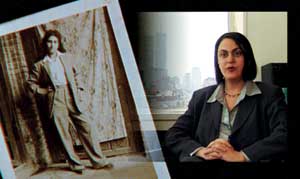 Don’t let the clumsy title fool you: its ease in unsettling the most basic assumptions regarding who is an Israeli and who’s not, who’s a Jew and who’s not, will win you over. Video artist Samir displays a mature understanding of Israel as a Middle Eastern country with Arabic Jewish citizens (Sephardim, or Mizrahim) who are decidedly skeptical about the Ashkenazi (European-descended) Jewish society in which they live. Interestingly, this complex portrait of Israel’s Iraqi Jews is the product of an Iraqi filmmaker, raised in Switzerland, who reveals that he is not a Jew at all but a Shiite Muslim. Samir describes his project ideologically: his father was a member of the Iraqi Communist Party, and so were the four men he tracks down in Israel and interviews in Arabic (probably a shock to Israeli audiences, given the prominence of one as a writer). On-screen, Samir plays with images, raiding archives for 1940s Egyptian musicals such as Fatma, Marika wa Rachel, and early examples of stereotyping such as the 1964 Israeli film Sallah Shabati. Samir registers disjunctions of time and place with a split screen that manages to work emotionally as something more than a gimmick; he clearly knows his tools and how to use them.
To counterbalance the fine old men in Israel, Samir goes to New York City to interview the wonderfully irreverent scholar of Israeli cinema Ella Shohat, who speaks at length about growing up in Israel as an Iraqi Jew. Shohat even lets us see a tape of her uproarious appearance on an Israeli talk show, when an argument with the host over whether Arabic Jews experience prejudice was settled by a shout-out from the audience. What a breath of fresh air!
To be added to our announcement list |
||||||||
|
Home |
Home Video Sales |
In Theaters |
Institutional Sales |
Events |
Festivals |
||||||||




